Benny
Man on FireBenny, known as Tattoo for the tattoos covering his huge arms, is a physically imposing Gozitan whose reputation rests on both spectacular violence and everyday helpfulness. His latest suspended sentence brings him back to Gozo, where the threat of being provoked into prison becomes a practical danger; his friendship with Creasy and his offer to help him reveal another side of a man others mainly fear.
Identity and Reputation
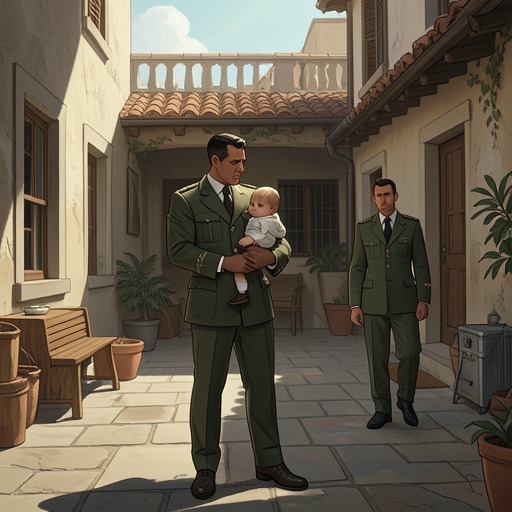
Benny is described as very big and very strong, with an appearance likened to that of a reject from Frankenstein. Although Gozitan, he had spent many years on Malta’s larger island. His nickname, Tattoo, points to the strikingly marked arms that make his physical presence immediately legible. The narration presents him as a local “character”: a figure whose alarming looks and forceful conduct have become part of his standing in the community.
That reputation is not merely theatrical. When police once came to arrest him, they did not relish the prospect of confronting him directly. They brought two Alsatian dogs and warned Benny through a megaphone that they would send the animals inside if he did not come out peacefully. After a short silence, the destruction in the room resumed. The dogs returned within half a minute, thrown out of a window with broken necks. The story makes Benny’s strength frighteningly concrete, while the police response shows that his notoriety affects how others approach even routine enforcement.
Violence, Punishment, and Return to Gozo
One earlier outburst followed a politician’s broken promise. Benny had worked hard to help the politician during an election after being promised a desirable government job in return. Once elected, the politician denied remembering the offer and refused to see him. Benny pushed past the secretary, but the office door was locked. He smashed it down; the politician escaped through a ground-floor window, while Benny wrecked the newly furnished office. When police arrived, they could still hear wood splintering. The judge sentenced Benny to only three months, influenced by neither affection for animals nor support for the politician.
His more recent trouble began with temporary work as a keeper of the peace in a bar on Strait Street in Valletta. Known as “the gut,” the street had long attracted sailors, but after the British naval base closed it fell on hard times. A few bars remained, some becoming drinking places for Malta’s tough gangs. Benny had enemies among them; while keeping order one night, he sent two men to the hospital for a long time. The same judge sentenced him to a year, suspended for six months.
To stay away from temptation while the suspension ran, Benny came home to Gozo and waited in relative seclusion. The deadline was close when Creasy heard that Benny was drinking in Marsalforn and that two enemies were on their way to provoke a fight. If Benny broke the peace before the suspension ended, he would have to serve the full year in jail. The group at Gleneagles knew that simply telling him to keep out of the way would not work: his pride would not permit it. Nor could they rely on the police, since the antagonists could wait for their opportunity and Benny would need little provocation. Creasy listened sympathetically but at first kept silent, weighing the problem himself.
Life in the Gozo Community
Benny’s period back home is not defined only by the danger of another fight. He is popular with local people and regularly appears at Gleneagles, where he has shared drinks with Creasy. He lends a hand with ordinary work, including pulling up a boat and painting a house. The same readiness to act can take a more intimidating form when an outsider causes difficulty: he is also willing to threaten one. In this small catalogue of services, physical force is at once a source of danger and part of the practical help he offers his community.
His place among the locals also differs from the way strangers read him. A peroxide-blond tourist, somewhat drunk and fascinated by Benny’s tough-guy image, twice knocked over Creasy’s glass, the second time while Benny was in the toilet. Creasy sharply challenged her. When she asked whether he was frightened of Benny, Benny answered that neither he nor Creasy was afraid of the other, then told her to be quiet or leave. The exchange gives the local bond a plain, unsentimental form: Benny does not demand that Creasy defer to him, and he does not treat their friendship as a performance for the tourist.
Relationship with Creasy and Narrative Role
Creasy likes Benny, and their connection is established through repeated ordinary contact rather than a formal alliance. They have had drinks together in Gleneagles; Creasy listens sympathetically when the group discusses Benny’s predicament. Benny, in turn, recognizes Creasy as someone he can approach directly. Their mutual ease stands against the fear and calculation surrounding the impending confrontation: Creasy’s silence at the bar is deliberative, while Benny’s pride makes a simple warning to stay away from danger ineffective.
Later, Benny brings Creasy a fresh drink and tells Nadia, “I take him away for a minute.” On the quiet balcony, he solemnly addresses Creasy as “Uomo” and says, “You ever need help, and you don't call me first-I get very mad.” Creasy smiles. Benny’s promise is not an abstract declaration of loyalty: it comes from a man known to answer conflict with overwhelming force, but whose place in Gozo also depends on helping people with boats, houses, and local troubles. The closing exchange makes that combination decisive. Benny remains formidable, yet his strength is directed toward a relationship of trust, and his offer leaves Creasy with a dependable ally in a world where help is rarely offered lightly.